
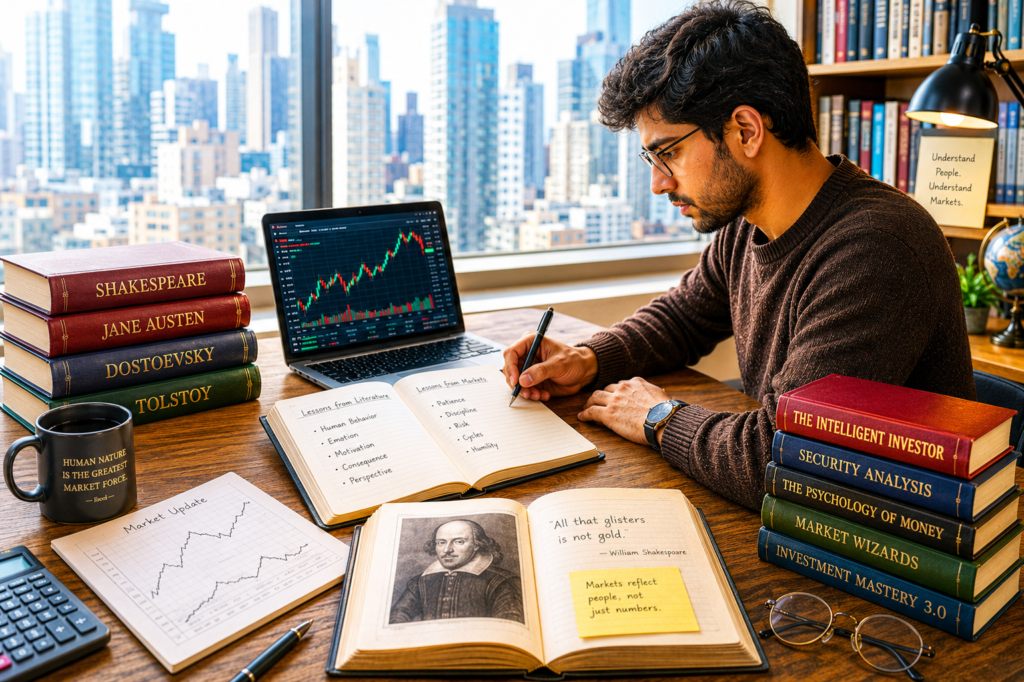
There was a time when I believed literature and markets belonged to two entirely different civilizations.
One lived in libraries, poetry, philosophy, and imagination.
The other lived in stock exchanges, balance sheets, inflation, and uncertainty.
One taught beauty.
The other taught survival.
I was wrong.
The deeper I moved into financial understanding, the more I realized that markets are never merely economic systems.
They are human stories written in numbers.
A market crash is a tragedy.
A speculative bubble is satire.
Inflation is dystopian fiction unfolding in real time.
And recovery is hope refusing to surrender.
Perhaps that is why my journey into markets did not truly begin with finance at all.
It began with loss.
The kind of loss that quietly forces an educated person to ask uncomfortable questions. Years of studying literature, philosophy, language, criticism, and theory had trained me to analyze Shakespeare, Eliot, Joyce, Keats, Faiz, and the complexities of human emotion. Yet despite all that education, I realized something painful:
An intellectually trained mind may still remain financially vulnerable.
At first, that realization felt humiliating.
Later, it became transformative.
The losses were real, and at times emotionally devastating. But with time, I stopped seeing them merely as failures. I began seeing them as tuition fees — expensive lessons paid not to a university, but to reality itself. Perhaps more costly than a semester at Harvard or Berkeley, but equally transformative in one important way: they forced me to upgrade myself.
That was the beginning of my journey from literature to markets.
After reading over fifty books on investing, economics, psychology, market history, behavioral finance, and business analysis — alongside the experience of completing Investment Mastery 3.0 — I discovered something astonishing:
Literature had prepared me for markets far more than I had ever imagined.
Because literature, at its finest, teaches us how human beings behave under pressure.
And markets are, ultimately, human behavior under pressure.
Perhaps that is why literature, more than almost any other discipline, trains the mind to observe people honestly.
Suddenly, Shakespeare no longer felt distant from Wall Street.
Hamlet taught me that hesitation and impulsiveness can destroy judgment alike; markets punish both emotional paralysis and reckless action.
Macbeth revealed how ambition without discipline eventually consumes itself — much like greed disguised as investment strategy.
King Lear became a warning against false confidence and the danger of trusting noise over wisdom.
Othello exposed how fear and insecurity can be manipulated; markets, too, are often moved by rumor long before they are corrected by reality.
Julius Caesar showed the frightening power of crowd psychology, persuasion, ambition, and betrayal — forces still visible in politics, economics, and stock markets every day.
Even Shakespearean comedy carries financial wisdom. In Twelfth Night, confusion, disguise, and mistaken identities slowly move toward recognition and balance. Markets behave similarly. Weak companies often appear glamorous, strong businesses remain temporarily ignored, and emotional crowds repeatedly confuse excitement with value. But eventually, excess corrects itself, panic settles, and reality returns to the stage.
Literature beyond Shakespeare deepened this realization even further.
Wordsworth taught me the discipline of observation. Markets also reward those who can remain calm enough to notice what others ignore.
Keats wrote:
A thing of beauty is a joy forever.
For years, I believed beauty belonged only to poetry. Later, I discovered there is also beauty in patience, disciplined thinking, healthy cash flow, rational valuation, and value recognized before the crowd notices it.
Shelley’s question —
If Winter comes, can Spring be far behind?
— began to feel less like poetry and more like the emotional rhythm of every market cycle in history.
Jane Austen understood inheritance, class anxiety, reputation, and financial survival long before economists gave such realities technical names.
Emily Brontë’s Wuthering Heights revealed how obsession can destroy peace — much like markets punish the obsession with instant wealth. As Catherine confesses, “Whatever our souls are made of,” human desire remains capable of both creation and ruin.
James Joyce captured the fragmentation of modern consciousness, while T. S. Eliot questioned the spiritual emptiness hidden beneath modern civilization:
Where is the wisdom we have lost in knowledge?
And perhaps Eliot’s The Hollow Men feels even more unsettling in today’s financial culture — a world where noise often replaces understanding, speculation imitates intelligence, and confidence appears long before wisdom.
Perhaps nowhere is Eliot’s question more relevant than in an age where millions chase financial success without first developing financial clarity.
Every day, social media creates urgency without understanding. Millions experience FOMO — the fear of missing out — chasing trends, screenshots, predictions, and emotional excitement without understanding intrinsic value, stability, cash flow strength, business quality, or long-term sustainability.
But markets eventually expose illusion.
That is why Warren Buffett’s timeless observation feels almost literary in its wisdom:
The stock market is a device for transferring money from the impatient to the patient.
That sentence changed the way I understood not only investing, but life itself.
Because real investing is not gambling.
It is disciplined interpretation.
Intrinsic value teaches us that price and worth are not always the same.
Margin of safety teaches humility before uncertainty.
Cash flow reveals truth beneath appearances.
And patience becomes more valuable than excitement.
One of the most fascinating ideas I encountered was the philosophy behind the Sarmaaya Score — a 0–100 health score combining profitability, valuation, growth, stability, cash flow strength, and overall business quality. What impressed me was not merely the metric itself, but the intellectual discipline beneath it: simplifying complexity without abandoning analytical depth.
Through Investment Mastery 3.0, mutual funds, macroeconomics, valuation analysis, inventory behavior, financial statements, gold cycles, business fundamentals, and cash flows gradually stopped feeling like isolated financial concepts. They became part of a larger language for understanding uncertainty, human behavior, and the modern world with greater clarity.
Gold became history’s memory of fear and trust.
Stocks became ownership in real businesses rather than lottery tickets.
Mutual funds became disciplined participation instead of blind dependence.
And financial education became less about money alone and more about awareness.
Slowly, the journey stopped becoming only financial.
It became educational, philosophical, and deeply personal.
Because eventually, one difficult question began echoing louder than all the others:
What is the purpose of education if an educated person still feels helpless before inflation, debt, financial confusion, emotional investing, or economic uncertainty?
And at the same time, what is the value of financial success if it produces wealth without wisdom, profit without ethics, or ambition without humanity?
Perhaps true education should do both: expand the imagination and strengthen one’s ability to survive reality with dignity.
Literature taught me how to understand human beings.
Markets taught me how human beings behave when fear, greed, hope, and uncertainty enter the room.
Benjamin Graham taught the discipline of value beneath appearance.
Peter Lynch taught the importance of understanding what one owns.
Ray Dalio revealed how economic cycles repeat because human behavior repeats.
Tony Robbins reminded millions that financial freedom is ultimately emotional freedom — the ability to live with less fear and greater clarity.
And perhaps that is why even brokers, analysts, and investors on Wall Street eventually discover the same truth:
Numbers alone never move markets.
Human emotions do.
That realization changed everything for me.
I no longer see literature and financial understanding as separate worlds.
One teaches us to read words.
The other teaches us to read reality.
And perhaps the future belongs to those capable of connecting both.
Steve Jobs once said:
You can’t connect the dots looking forward; you can only connect them looking backward.
Looking back now, the dots feel clearer.
The books were never useless.
The losses were never meaningless.
Markets were never merely about money.
Everything, somehow, was teaching interpretation.
It also became impossible to ignore why thinkers like Sigmund Freud and Carl Jung fascinated me for so long. Both sought to understand the hidden fears, desires, and unseen forces shaping human behavior — and markets, in many ways, reveal those same emotions every day beneath charts, headlines, valuations, greed, fear, and uncertainty.
Perhaps that is why literature and investing no longer seem distant to me. Both require the ability to look beneath appearances and interpret what others fail to see.
And perhaps that is why I believe the future will belong not merely to specialists, but to people capable of connecting worlds — people who can combine philosophy with economics, literature with markets, imagination with discipline, and education with life itself.
And maybe the most important question for this generation is no longer:
What degree do you have?
But rather:
Have you upgraded yourself enough to understand the world you are living in?
True wealth does not begin when money enters your hands. It begins when clarity enters your mind.


A truly inspiring reflection on how education, lifelong learning, and real-world understanding can beautifully connect with each other. This blog reminds us that growth begins the moment we allow ourselves to learn beyond boundaries.
Thank you for such a meaningful response. One of the central ideas behind this piece was to encourage a wider conversation about how knowledge, experience, and self-development often intersect in unexpected ways. I’m really glad the reflection connected with you, and I hope others will join the discussion after reading it as well.
Such a refreshing perspective as students of literature the dilemma is not new to us, only the answers are.
In many ways, students of literature have long recognized these tensions; what continues to evolve is how we interpret and respond to them in changing social and economic contexts. It would be interesting to see how others within the humanities view this relationship as well.
Nicely written and logically explained the delicate but intertwined balance between literature, market and emotions.
Sir, thank you for your thoughtful observation. The connection between literature, markets, and emotions ultimately reflects the role of human behavior in shaping both intellectual and economic realities. Discussions like these are important in encouraging more interdisciplinary ways of thinking.
I am amazed after reading this blog, Sir. I believed that not a single person from a language or literature background could be familiar with investments and finance. I have also never seen someone talk so explicitly about their losses, which will definitely help new investors gain the right insights into this market. You’re a SuperMan, Sir. 🥰
One of the central purposes behind writing this reflection was precisely to challenge the assumption that literature and financial understanding belong to separate worlds. The more I explored markets, the more I realized that investing is deeply connected to human behavior — something literature has always examined in profound ways.
And yes, I intentionally mentioned the losses. Success is often displayed publicly, while the lessons hidden inside failure remain ignored, even though they frequently become the most valuable form of education.
Perhaps the larger realization is that no discipline exists in isolation. Once we begin looking carefully, philosophy, psychology, economics, literature, and life itself start connecting in unexpected ways.
𝙄𝙩 𝙬𝙖𝙨 𝙖𝙬𝙚𝙨𝙤𝙢𝙚👍
.
Thank you. I’m really glad you enjoyed reading it.
Sir, I’ve never heard anyone describe a market crash as a tragedy and a bubble as satire, but now that you’ve said it, I can’t see it any other way. You’ve basically proven that a library card is just as important as a brokerage account. It’s rare to find someone who can find the ‘poetry’ in a cash flow statement, but you’ve made the transition from Keats to Buffett look like the most natural evolution in the world.
Never limit yourself to a single discipline or assume that your academic background defines the boundaries of your future. Real learning often begins when we allow different worlds of knowledge to interact with each other. Curiosity, adaptability, and continuous self-development can open doors we never originally imagined.
Your passage felt deeply personal and inspiring to read because it reflects not only intellectual depth but also genuine wisdom shaped by experience. I truly admired the way you connected the ideas of Sigmund Freud and Carl Jung with the emotional realities of markets and human behavior, showing how literature, psychology, philosophy, and investing are all connected through the study of human nature. What makes your writing so impactful is that it encourages readers to think beyond conventional definitions of education and success. The line about combining “philosophy with economics, literature with markets, imagination with discipline, and education with life itself” was especially powerful and beautifully written. I also found the concluding question incredibly thought-provoking because it challenges readers to focus not only on qualifications but on continuous self-growth and understanding of the world around them. Overall, your words feel sincere, visionary, and deeply relevant, and they leave the reader reflecting long after finishing the passage.
What fascinates me more and more is how artificially separated our disciplines have become, even though real life never works that way. Human behavior moves through literature, psychology, economics, politics, and markets all at once. Perhaps literature still matters so deeply because it trains us to notice patterns beneath the surface — and maybe that ability is becoming more valuable than ever.
Your reflection beautifully reveals that true education is not confined to books or markets alone, but lies in developing the wisdom to understand both human emotion and human reality. That is wonderful,thank you.
I think one of the most important things education can do is help us understand life more honestly — not only through theories and books, but also through experience, uncertainty, and human behavior. I’m really glad the reflection connected with you.
After reading this article, I feel it is truly helpful for understanding the literary, emotional, and financial world, and most importantly, the connection between them. The article was deeply insightful and inspiring.
Thanks for sharing your knowledge with us
What I really learned from this is that knowledge is not limited to one subject or degree.t’s about how we connect ideas and understand human behavior in different fields. It made me realize that real learning is about developing clarity of mind, thinking beyond surface level, and becoming someone who can interpret the world in a deeper way.
Respected Sir,
The way you amazingly connect human reflection, critical thinking and market awareness shows a truly interdisciplinary vision. It is both, enlightening and inspiring for all of us. More Power to you 👏🏻
It is an amazing piece of writing. As a literature student, I had never seriously considered business, as my primary aspiration was to become a teacher. However, after reading this blog, I am now inspired to explore entrepreneurship and consider starting my own business. Overall, it is highly insightful and truly a game changer for literature students and scholars alike.
Wow!! What makes this reflection so engaging is the way it connects literature, psychology, and financial understanding through the thread of human behavior. I especially appreciated how writers from completely different eras, genres, and intellectual traditions, from Shakespeare and Austen to Eliot, Freud, and Jung, were brought together so seamlessly to explain the emotional realities of markets and modern life. The idea that “markets are human stories written in numbers” gives the article a depth that feels both intellectually rich and genuinely human.
The Author’s catholicity of reading enabled him to draw connections across disciplines!
Contemporary man is undone not by arithmetic inaccuracies but by the unresolved contradictions of his own consciousness. Canonical literature repeatedly cautions that never allow ephemeral emotions to dictate judgment, since such surrender inexorably leads to disintegration. The insight cultivated through literary engagement is therefore not merely aesthetic but existential, enabling one to interrogate and traverse realities far beyond the literary sphere.
The way you combine human insight, critical thinking, and market awareness reflects a truly multidimensional vision. Your thoughts are not only enlightening but also deeply inspiring for all of us. Wishing you continued success and strength.
Everything has a story – every object , every moment, every life, and art of telling that story falls under the realm of literature. This is a story of market , money, trade, and economics through the lens of literature. Writer is a born story teller. A delicious food for thought – not only shared with my students of Literature and economics but will conduct a session over it in class and reading club. Thanks for sharing.
“For years, I believed beauty belonged only to poetry. Later, I discovered there is also beauty in patience, disciplined thinking, healthy cash flow, rational valuation, and value recognized before the crowd notices it.”
No wonder to have witnessed such a great piece of work from you being a multidimensional and highly creative personality. Your insights, critical thinking, analytical prowess and knowledge about life, literature, history and modern civilization has enabled many individuals to inspire people around the world. I still remember how passionately you used to teach us short story back in 2011. Your lessons are life learned. I wish you every success in life.
Thank you Sir !
Muhammad Asif, reading your journey moved me deeply. The way you have connected literature with markets — describing a crash as tragedy and recovery as hope — reflects a mind that truly sees beyond numbers. I am incredibly proud of how far you have come, turning painful losses into powerful wisdom. Your words are an inspiration not just to fellow students, but to anyone who has ever doubted whether they belong in the world of finance. Keep writing, keep learning, and keep investing — both in markets and in yourself. Wishing you great success in all your investments ahead. The best chapters of your story are still being written
Dr. Muhammad Asif’s reflection is, at one level, an essay about finance. But at a deeper level it is really an essay about epistemology: about how human beings come to know reality, and about the tragic limitations of educational systems that divide knowledge into isolated compartments. His central insight — that markets are “human stories written in numbers” — is psychologically profound because it reframes economics not as a purely mathematical phenomenon but as an emotional, symbolic, and cultural process.
What makes the piece compelling is that it unconsciously moves toward a synthesis that thinkers across disciplines have attempted for centuries: the reconciliation of imagination and survival, aesthetics and utility, psyche and economy, culture and material life.
From the perspective of psychology, the essay is fundamentally about human behavior under uncertainty. This is precisely where literature, psychoanalysis, behavioral economics, and cultural psychology intersect.
The references to Shakespeare are not ornamental. They are diagnostic. Shakespeare understood what modern psychology later formalized: that human beings are not consistently rational creatures. Macbeth is greed fused with narcissistic grandiosity. Othello is cognitive distortion manipulated through suggestion and insecurity. King Lear dramatizes ego fragility and the collapse of judgment under emotional blindness. Hamlet embodies paralysis through over-analysis — what modern cognitive psychology might describe as maladaptive rumination.
In this sense, markets are not merely financial systems. They are collective psychological theaters.
One of the strongest parts of the essay is the movement from personal financial loss toward existential transformation. Here the reflection enters territory explored by both Freud and Jung. Freud would likely see the market as a stage upon which unconscious desires — security, dominance, fear, immortality, validation — become displaced into money, speculation, and accumulation. Jung, meanwhile, would immediately recognize the symbolic dimensions of markets: cycles of fear and euphoria resemble archetypal rhythms of death and rebirth. Bull and bear markets almost function as modern mythological narratives.
The essay’s recurring concern with illusion versus reality is also deeply psychological. Financial bubbles are essentially socially reinforced cognitive distortions. Entire populations begin participating in collectively shared fantasies. Behavioral finance later gave technical language to what literature and psychoanalysis had long observed intuitively: projection, herd mentality, emotional contagion, confirmation bias, irrational exuberance, denial, and panic.
This is precisely why the essay succeeds when it argues that literature prepared the author for markets. Literature trains perception. It develops sensitivity to motives, contradictions, symbols, irrationality, and hidden emotional structures. In psychological terms, literature expands mentalization — the ability to understand minds, motives, and emotional complexity.
But perhaps the most important dimension of the reflection is not psychological alone. It is civilizational.
The essay quietly critiques the fragmentation of modern education. Colonial and industrial models of education separated economics from philosophy, psychology from literature, and ethics from commerce. Yet real human life never operates in such compartments. Inflation affects dignity. Debt affects relationships. Markets influence identity, anxiety, family systems, and political behavior. Economics is never merely economic.
This is where my own longstanding interest in indigenous and interdisciplinary psychology becomes especially relevant.
South Asian intellectual traditions historically resisted these rigid divisions. Classical Islamic, Persian, Sanskritic, and Punjabi intellectual cultures did not isolate poetry from philosophy, spirituality from economics, or ethics from politics. A figure like Bulleh Shah, Waris Shah, Rumi, or even Muhammad Iqbal would not have recognized the modern university’s compartmentalized worldview. Knowledge was seen as interconnected because the human being himself was understood as interconnected.
Indeed, Punjabi and Urdu literary traditions possess a deep psychological realism often ignored by modern academic psychology. The poetry of Bulleh Shah, Waris Shah, Faiz Ahmed Faiz, and Mian Muhammad Bakhsh repeatedly explores longing, ego, fear, power, social hierarchy, alienation, greed, and spiritual emptiness — themes equally relevant to markets and modern capitalism.
I could even argue that contemporary financial culture intensifies the very psychological conditions that both Sufi poetry and existential philosophy warned against:
alienation,
compulsive comparison,
identity through status,
fear-driven accumulation,
loss of inner stability,
and the replacement of wisdom with noise.
This is why T. S. Eliot’s line quoted in the essay —
“Where is the wisdom we have lost in knowledge?”
— feels devastatingly contemporary.
Social media investing culture has transformed finance into spectacle. Screenshots replace understanding. Performance replaces wisdom. Identity becomes tied to visibility and consumption. From a psychological perspective, modern digital capitalism increasingly monetizes attention, insecurity, and impulsivity.
And yet the essay refuses cynicism. That is its strength.
It does not reject markets. Rather, it seeks to humanize financial understanding through reflection, ethics, patience, and interpretation. In this regard, the invocation of Warren Buffett, Benjamin Graham, and Peter Lynch becomes fascinating. These figures are often treated merely as investors, but psychologically they are philosophers of temperament. Buffett’s emphasis on patience is fundamentally emotional regulation. Graham’s “margin of safety” is structured humility before uncertainty. Lynch’s insistence on understanding what one owns reflects cognitive clarity over emotional contagion.
The essay’s final question —
“Have you upgraded yourself enough to understand the world you are living in?”
— is therefore not really about finance. It is about consciousness.
And perhaps that is the deepest interdisciplinary insight of all: true education is not the accumulation of disconnected information. It is the cultivation of interpretive wisdom.
My own work repeatedly circles this same idea. Whether through psychology, organizational culture, indigenous knowledge systems, leadership training, Sufism, or literature, the underlying concern is identical: how do human beings construct meaning within rapidly changing social realities?
That is why reflections like Dr. Asif’s resonate so strongly today. They emerge from a growing recognition that the crises of the modern world are not merely technological or economic. They are crises of interpretation.
We possess unprecedented information, yet often lack wisdom. We possess connectivity, yet experience alienation. We possess financial systems, yet remain psychologically fragile. We possess specialization, yet increasingly lose wholeness.
Perhaps the future genuinely belongs to those capable of reconnecting fragmented forms of knowledge: psychologists who understand culture, economists who understand emotion, literary scholars who understand power, leaders who understand human vulnerability, and educators who understand that survival and imagination are both necessary for civilization.
In that sense, Dr. Asif’s essay is not merely a reflection on markets. It is part of a larger intellectual movement toward recovering the unity of human knowledge itself
Respected Sir,
I read your reflection several times, and with each reading I felt you were responding not only to the essay itself, but to many of the tensions beneath it that I had only intuitively sensed while writing.
What stayed with me most was your idea that modern society is facing a “crisis of interpretation.” I think that line captures something far larger than markets alone. We live in a time flooded with information, analysis, commentary, and visibility, yet genuine understanding often feels increasingly rare.
Your discussion of markets as collective psychological theatres was equally fascinating to me. While writing the piece, I was approaching many of these ideas through literature, experience, and observation, but your response gave them a much broader psychological and civilizational context. The connections you drew between Shakespeare, Freud, Jung, behavioral economics, and indigenous intellectual traditions felt remarkably organic rather than merely interdisciplinary.
What I appreciated most, however, was the seriousness with which you engaged the reflection. Thoughtful reading itself has become rare. To see someone invest such intellectual attention and generosity into a public discussion was genuinely encouraging.
Your response also left me thinking about a larger question: whether contemporary universities still meaningfully encourage synthesis across disciplines, or whether specialization has gradually made that kind of intellectual wholeness more difficult to sustain.
Thank you once again for such a generous and deeply thought-provoking reflection.
Such a thoughtful, deeply personal, and ultimately joyful post! Only a fraction of people manage to become truly expert in some field that requires lifelong dedication. And when one of those takes their now well-honed curiosity, focus and critical thinking into a new, seemingly unrelated (surprises to come!) complex discipline, the tale of that journey of discovery will be a fascinating read, if only the adventurer is kind enough to share it, as here. Thanks!
Beautifully written Sir. I’ve always admired how you bring literature to life in the classroom. The way you connect Hamlet’s hesitation to market psychology, or Shelley’s spring to economic recovery, feels so natural. Genuinely Eye-opening. I enjoyed reading it✨.