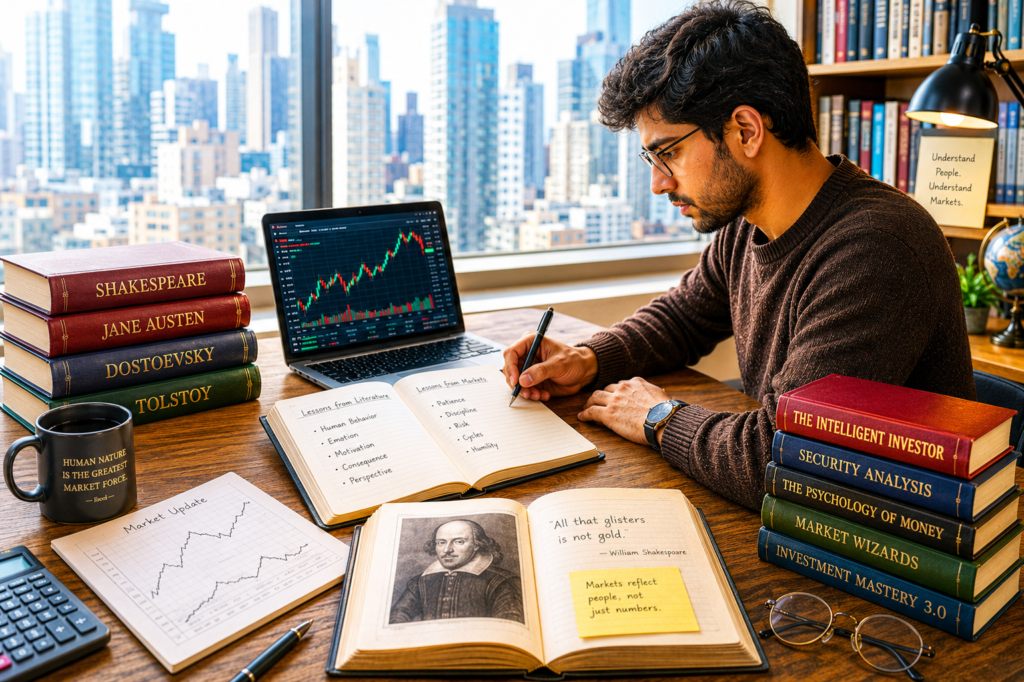
From Literature to Markets: A Reflective Journey into Financial Understanding
There was a time when I believed literature and markets belonged to two entirely different civilizations. One lived in libraries, poetry, philosophy, and imagination.The other lived in stock exchanges, balance sheets, inflation, and uncertainty. One taught beauty.The other taught survival. I was wrong. The deeper I moved into financial understanding, the more I realized that markets are never merely economic systems. They are human stories written in numbers. A market crash is a tragedy.A speculative bubble is satire.Inflation is dystopian fiction unfolding in real time.And recovery is hope refusing to surrender. Perhaps that is why my journey into markets did not truly begin with finance at all. It began with loss. The kind of loss that quietly forces an educated person to ask uncomfortable questions. Years of studying literature, philosophy, language, criticism, and theory had trained me to analyze Shakespeare, Eliot, Joyce, Keats, Faiz, and the complexities of human emotion. Yet despite all that education, I realized something painful: An intellectually trained mind may still remain financially vulnerable. At first, that realization felt humiliating. Later, it became transformative. The losses were real, and at times emotionally devastating. But with time, I stopped seeing them merely as failures. I began seeing them as tuition fees — expensive lessons paid not to a university, but to reality itself. Perhaps more costly than a semester at Harvard or Berkeley, but equally transformative in one important way: they forced me to upgrade myself. That was the beginning of my journey from literature to markets. After reading over fifty books on investing, economics, psychology, market history, behavioral finance, and business analysis — alongside the experience of completing Investment Mastery 3.0 — I discovered something astonishing: Literature had prepared me for markets far more than I had ever imagined. Because literature, at its finest, teaches us how human beings behave under pressure.And markets are, ultimately, human behavior under pressure. Perhaps that is why literature, more than almost any other discipline, trains the mind to observe people honestly. Suddenly, Shakespeare no longer felt distant from Wall Street. Hamlet taught me that hesitation and impulsiveness can destroy judgment alike; markets punish both emotional paralysis and reckless action. Macbeth revealed how ambition without discipline eventually consumes itself — much like greed disguised as investment strategy. King Lear became a warning against false confidence and the danger of trusting noise over wisdom. Othello exposed how fear and insecurity can be manipulated; markets, too, are often moved by rumor long before they are corrected by reality. Julius Caesar showed the frightening power of crowd psychology, persuasion, ambition, and betrayal — forces still visible in politics, economics, and stock markets every day. Even Shakespearean comedy carries financial wisdom. In Twelfth Night, confusion, disguise, and mistaken identities slowly move toward recognition and balance. Markets behave similarly. Weak companies often appear glamorous, strong businesses remain temporarily ignored, and emotional crowds repeatedly confuse excitement with value. But eventually, excess corrects itself, panic settles, and reality returns to the stage. Literature beyond Shakespeare deepened this realization even further. Wordsworth taught me the discipline of observation. Markets also reward those who can remain calm enough to notice what others ignore. Keats wrote: A thing of beauty is a joy forever. For years, I believed beauty belonged only to poetry. Later, I discovered there is also beauty in patience, disciplined thinking, healthy cash flow, rational valuation, and value recognized before the crowd notices it. Shelley’s question — If Winter comes, can Spring be far behind? — began to feel less like poetry and more like the emotional rhythm of every market cycle in history. Jane Austen understood inheritance, class anxiety, reputation, and financial survival long before economists gave such realities technical names.Emily Brontë’s Wuthering Heights revealed how obsession can destroy peace — much like markets punish the obsession with instant wealth. As Catherine confesses, “Whatever our souls are made of,” human desire remains capable of both creation and ruin. James Joyce captured the fragmentation of modern consciousness, while T. S. Eliot questioned the spiritual emptiness hidden beneath modern civilization: Where is the wisdom we have lost in knowledge? And perhaps Eliot’s The Hollow Men feels even more unsettling in today’s financial culture — a world where noise often replaces understanding, speculation imitates intelligence, and confidence appears long before wisdom. Perhaps nowhere is Eliot’s question more relevant than in an age where millions chase financial success without first developing financial clarity. Every day, social media creates urgency without understanding. Millions experience FOMO — the fear of missing out — chasing trends, screenshots, predictions, and emotional excitement without understanding intrinsic value, stability, cash flow strength, business quality, or long-term sustainability. But markets eventually expose illusion. That is why Warren Buffett’s timeless observation feels almost literary in its wisdom: The stock market is a device for transferring money from the impatient to the patient. That sentence changed the way I understood not only investing, but life itself. Because real investing is not gambling. It is disciplined interpretation. Intrinsic value teaches us that price and worth are not always the same.Margin of safety teaches humility before uncertainty.Cash flow reveals truth beneath appearances.And patience becomes more valuable than excitement. One of the most fascinating ideas I encountered was the philosophy behind the Sarmaaya Score — a 0–100 health score combining profitability, valuation, growth, stability, cash flow strength, and overall business quality. What impressed me was not merely the metric itself, but the intellectual discipline beneath it: simplifying complexity without abandoning analytical depth. Through Investment Mastery 3.0, mutual funds, macroeconomics, valuation analysis, inventory behavior, financial statements, gold cycles, business fundamentals, and cash flows gradually stopped feeling like isolated financial concepts. They became part of a larger language for understanding uncertainty, human behavior, and the modern world with greater clarity. Gold became history’s memory of fear and trust.Stocks became ownership in real businesses rather than lottery tickets.Mutual funds became disciplined participation instead of blind dependence.And financial education became less about money alone and more about awareness. Slowly, the journey stopped becoming only financial. It